

 Facebook
 X
X
 Pinterest
 Copy Link
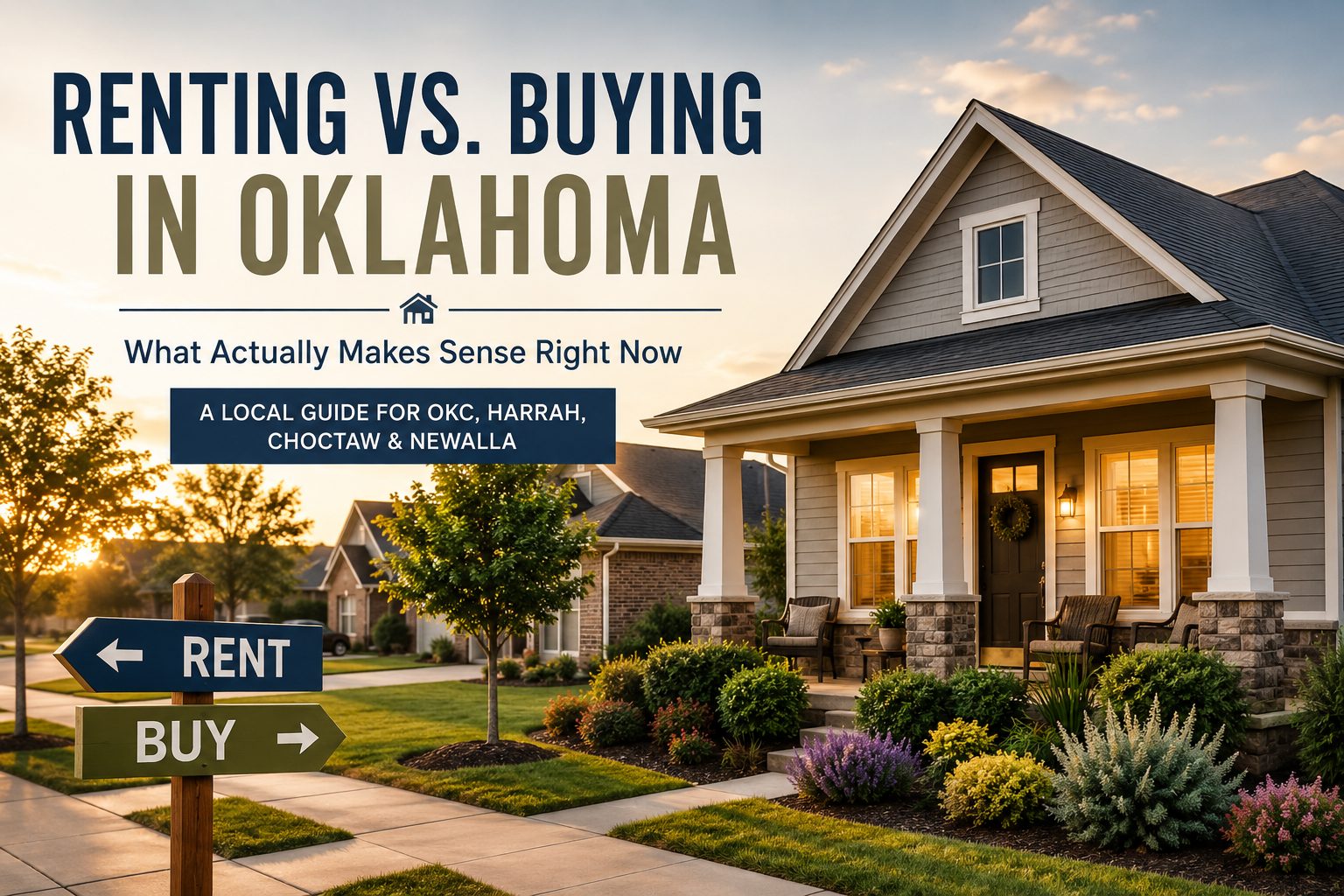
Most people frame the “rent vs. buy in Oklahoma” decision the wrong way.
They treat renting like money down the drain and buying like an automatic win. But the truth is more nuanced than that — and a lot more useful when you slow it down and look at your actual life.
Here’s what I’ve seen working with buyers and renters across the Oklahoma City metro, including Harrah, Choctaw, and Newalla: the right answer has far less to do with a rule of thumb and far more to do with your timeline, your finances, and what you want your next few years to look like.
What Renting Is Really Giving You
Renting isn’t wasted money. It’s buying flexibility.
And flexibility matters more than people give it credit for.
If you’re new to the area, still figuring out which part of town feels right, or working on paying down debt before taking on a mortgage, renting gives you breathing room. No long-term commitment. No surprise repair bills. Just time and stability while you figure things out.
That said, rents in the Oklahoma City metro have climbed steadily. In places like Choctaw and Harrah, many three-bedroom rentals are now close to what a mortgage payment would be on a comparable home.
The rent vs buy in Oklahoma conversation has become more common as that gap continues to narrow across the OKC metro.
When that gap starts shrinking, it’s worth paying attention to what you’re actually getting for your money each month.
Why Equity Changes the Conversation
When you own a home, your payment isn’t just an expense — it’s a form of forced savings.
Every mortgage payment chips away at your loan balance and builds equity. Rent doesn’t do that.
Over time, that difference can add up to a meaningful gap in long-term wealth.
In communities like Newalla and Harrah, this has already played out. As buyers were priced out of closer-in Oklahoma City neighborhoods, demand shifted east. Home values in these areas have steadily increased over the last decade, and homeowners who bought even a few years ago have likely seen real equity growth.
No one can promise what the next decade looks like. But the fundamentals here — affordability, land availability, schools, and commute access — continue to support long-term demand.
The Part Nobody Likes to Talk About
Buying a home costs more than the mortgage.
There are closing costs (usually 2–5%), insurance, taxes, and ongoing maintenance. A good rule of thumb is to budget about 1-2% of the home’s value each year for repairs and upkeep.
On a $250,000 home, that’s roughly $2,500 to $5,000 a year — or about $200 to $415 a month you need to mentally account for.
If a single repair would push you into debt, that’s usually a sign to wait. Not forever — just until your savings and stability catch up with your goals.
So When Does Buying Make Sense?
Buying starts to make the most sense when you’re planning to stay put for at least 3–5 years.
That’s typically the point where equity growth and appreciation begin to outweigh the upfront costs of buying and maintaining a home.
In areas like Choctaw, Harrah, and Newalla — where you can still find homes in the $220K–$350K range — buying can be a very solid option for households with stable income and a reasonable down payment saved.
Not because buying is always “better,” but because the conditions here support long-term ownership for the right situation.
The Real Bottom Line
Renting makes sense when you need flexibility, are still building financial stability, or aren’t ready to take on maintenance and long-term commitment.
Buying makes sense when you’re ready to settle, have the financial cushion in place, and want your monthly payment to start building equity instead of just covering housing.
Neither choice is wrong.
The best decision is the one that actually fits your life — not a timeline someone else made up.
If you’re trying to figure out where you fall in all of this, I’m always happy to talk it through with you.
— Rachel Mitine
rachelmitine@judgefite.com


